Home › Guides › Pocket money by age
How much pocket money (allowance) by age?
Updated November 2026
A common starting point in the US is $1 a week for each year of a child’s age, so $6 a week at six and $10 at ten. Real families give less than that to younger children and more to teenagers: in the UK, regular pocket money averages about £2.69 a week at six and £7.95 at seventeen. Below are the rules of thumb, what surveys in the US, UK and Australia found, and the choices that matter more than the amount: paid or given, and what happens to the money once they have it.
None of this is financial advice. The right amount depends on what the money is meant to cover, what your family can afford, and what other kids at school get. A teenager who buys their own lunches and phone credit needs a lot more than a seven-year-old saving for Lego.
Rules of thumb for allowance by age
- $1 per year of age, per week. U.S. Bank describes this as a common approach, with most children ready for an allowance around five or six (U.S. Bank). A 6-year-old gets $6 a week, a 12-year-old $12.
- Half that. Some families use 50 cents per year of age, especially for younger children whose money only buys treats.
- Age in coins. For under-fives, some families give their age in coins rather than dollars or pounds: four coins for a four-year-old. Counting them matters more than what they’re worth.
- Work out what it covers. For older children, add up what you already spend on their treats, outings and extras each month, and hand that over as an allowance instead. It costs you nothing extra, and they learn to make it last.
What families actually give: surveys from the US, UK and Australia
These are the most recent figures we could check, each with its source. They come from different methods, so compare within a country rather than across them.
United Kingdom
NatWest Rooster Money’s 2026 Pocket Money Index uses data from more than half a million Rooster Card users from March 2025 to February 2026. Regular pocket money averaged £3.94 a week; with chores and extra top-ups included, it averaged £9.74 a week (NatWest Rooster Money).
| Age | Regular pocket money a week | Including chores and top-ups |
|---|---|---|
| 6 | £2.69 | £4.58 |
| 8 | £2.88 | £5.10 |
| 10 | £3.27 | £6.08 |
| 12 | £4.01 | £9.15 |
| 14 | £5.10 | £13.97 |
| 16 | £6.68 | £21.26 |
| 17 | £7.95 | £22.56 |
Source: NatWest Rooster Money Pocket Money Index 2026. Figures from families using a children’s money card, so they may not match every household.
United States
Greenlight, a US children’s debit card, published average weekly allowances by age from its own families’ 2025 data (Greenlight). They’re a little above the $1-a-year rule at 5, below it from about 9 to 13, and above it again by 17.
| Age | Average weekly allowance | $1 per year of age |
|---|---|---|
| 5 | $6.18 | $5 |
| 7 | $6.79 | $7 |
| 9 | $7.86 | $9 |
| 11 | $9.35 | $11 |
| 13 | $11.59 | $13 |
| 15 | $15.26 | $15 |
| 17 | $21.47 | $17 |
Source: Greenlight, 2025 data from families using its app.
Australia
Westpac surveyed 1,007 Australian parents of 8 to 17 year olds in March and April 2025. Parents who give pocket money gave an average of about A$25 a week, compared with about A$9.27 a week they remembered getting as children. 55% of children in that age group earn their pocket money by doing chores (Westpac, September 2025). That average covers a wide age range, so a younger child would usually get much less and an older teenager more.
Paid for chores, or just given?
This is the bigger decision, and families genuinely differ. The common options:
- A set allowance, no strings. The money is for learning to manage money. Chores are expected anyway, as part of the family. It keeps the two lessons separate.
- Earned by chores. Each chore is worth something, and what you earn is what you get. It ties money to work, but some kids opt out of chores when they don’t need cash that week.
- A base amount plus extras. A small allowance for everyday chores, and extra for bigger jobs like washing the car, mowing or cleaning out the garage. This is where many families end up.
Whichever you choose, write it down and stick to it for a few months before changing it. Children cope well with almost any rule, as long as it’s the same rule every week. For which chores fit which age, see our chores by age list.
Saving, spending and giving
A simple way to teach what money is for is to split each payment into jars or pots. U.S. Bank describes a “one-third rule”: equal parts for saving, spending and giving. Some families use other splits, like half to spend and half to save. A few ideas that help:
- Give the saving a goal. “Save some” is vague. “Save $40 for the scooter” has an end. A picture of the scooter on the fridge helps a lot.
- Let them make small mistakes. If they spend it all on day one, the lesson arrives on day four. Don’t top it up.
- Match their saving. Some parents add a little to whatever a child saves, like interest, so waiting pays off.
- Make giving concrete. A school fundraiser, an animal shelter, a gift for a grandparent. Children understand giving best when they choose where it goes.
Coins as a stepping stone for young children
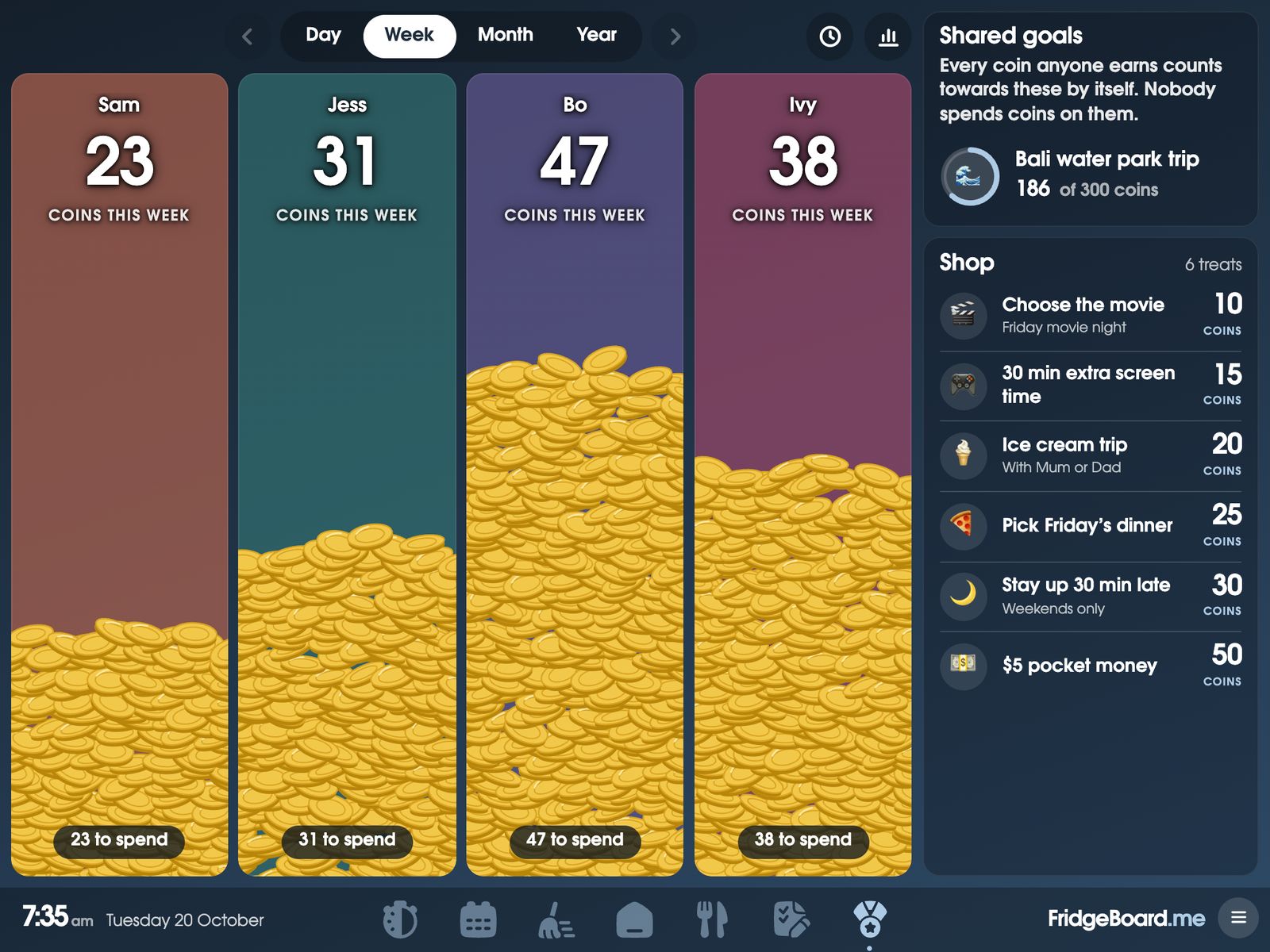
Under-sixes often don’t get money yet. A dollar coin and a twenty-cent piece feel about the same. Points or coins that they can see build up are an easier start: they earn a few for helping, watch the pile grow, and swap them for something they can picture, like choosing the movie or an ice cream trip.
As they get older, the same coins can be swapped for real money at a rate you set, like 10 cents a coin. Children learn to wait and save with something they can see, and the jump to real pocket money later is small.
Doing this with FridgeBoard
FridgeBoard is a family screen on an iPad or tablet on the fridge, kept in sync with every phone at home. Its chore chart can pay in coins:
- Give any chore a value in coins. Each child’s coins show on the fridge and on parents’ phones.
- Fill a shop with treats and real pocket money at a rate you choose, like 50 cents a coin. Children spend coins on the fridge.
- Set a shared goal the whole family saves towards, like a day out.
- Every coin earned or spent is in the History, and a household PIN stops children giving themselves coins.
Coins are optional, and some families use them only for extra jobs. More about coins and rewards.
Setting it up
- On your phone, go to fridgeboard.me and tap Try it free. Add who lives at home.
- Add chores and give the ones you want to pay for a value in coins.
- Fill the shop with treats and, if you like, pocket money at your own rate.
- On the iPad, open Safari, go to fridgeboard.me, tap Open, then Use this as the shared screen, and scan the code with your phone.
Questions
How much allowance should a 10 year old get?
A common US rule of thumb is $1 per year of age a week, so about $10. Greenlight’s 2025 data put the average at $8.53 a week for 10-year-olds, and in the UK regular pocket money for a 10-year-old averaged £3.27 a week in 2026.
How much pocket money should a 7 year old get?
In the UK, regular pocket money for a 7-year-old averaged £2.79 a week in NatWest Rooster Money’s 2026 index. In the US, Greenlight’s 2025 data put it at about $6.79 a week, close to the $1 per year of age rule.
What is the average pocket money in Australia?
Westpac’s 2025 survey found parents of 8 to 17 year olds who give pocket money gave about A$25 a week on average. That covers a wide age range, so younger children usually get less.
Should allowance be tied to chores?
Families do it both ways. Many give a small set allowance and pay extra for bigger jobs, so everyday chores stay part of family life and extra work earns extra money.
What age should kids start getting pocket money?
Many children are ready around 5 or 6, when they can count and understand that money runs out. Younger children can start with coins or points swapped for treats.
Can FridgeBoard track allowance or pocket money?
Yes. Chores earn coins, and coins can be spent in a shop you fill, including real pocket money at a rate you choose. It’s one payment for the household (US$24 plus tax in the US, A$39 in Australia), with no subscription.