Home › Guides › Chores without nagging
How to get kids to do chores without nagging
Updated November 2026
Kids mostly don’t do chores because the job is vague, the deadline is “later”, and the only reminder is you. Fix those three things: make the chores visible where they’ll see them, give each one a clear finish-by time, and let something other than your voice do the reminding. Add turns for the jobs nobody wants, a small reward for finishing, and a calm consequence when it doesn’t happen, and the nagging drops away.
First, a bit of kindness for everyone involved. Children aren’t being difficult on purpose most of the time. Chores are boring, their brains are busy with other things, and “empty the dishwasher” has no natural moment when it must happen. Adults are the same with the gutters. The aim isn’t a perfectly obedient child. It’s a house where the jobs get done and nobody’s voice is hoarse.
1. Make the chores visible
If the list lives in your head, you are the list, and every reminder comes from you. Put it somewhere they walk past many times a day, at their eye level: the fridge, the back of the pantry door, by the front door.
- One list per child. A shared list lets everyone assume someone else will do it.
- Today only. A whole week on one chart is a lot to read at 7am. Show what’s due today.
- Ticks they make themselves. Crossing a job off feels good, and it tells you it’s done without asking.
The American Academy of Pediatrics suggests posting chore charts or checklists as visual reminders and having children do chores at the same time each day (HealthyChildren.org, AAP).
2. Give every chore a finish-by time
“Can you empty the dishwasher?” invites “in a minute”. “The dishwasher is emptied by 5pm” is a deal. The child chooses when, inside a clear window, and you don’t have to watch.
- Tie it to something that happens anyway. Before screen time, before dinner, before leaving for school.
- “When, then”. “When your room is tidy, then the iPad comes out.” It isn’t a threat, just the order things go in.
- Check at the time, once. If it’s done, say thanks. If it’s not, the consequence happens without a lecture.
3. Be specific about what done means
Many “they won’t do chores” fights are really “they did it, just not the way I meant”. Break bigger jobs into steps they can see:
| Instead of | Try |
|---|---|
| Clean your room | Clothes in the basket, toys in the box, books on the shelf, bed made |
| Help in the kitchen | Plates in the dishwasher, wipe the table, push in the chairs |
| Feed the dog | One scoop of food, fill the water bowl, tick it so nobody feeds him twice |
| Get ready for school | Dressed, breakfast, teeth, shoes, bag at the door |
Teach a new chore by doing it together first, then watching them do it, then letting them do it alone. Our chores by age guide has lists for each age and more on teaching a chore.
4. Take turns for the jobs nobody wants
“I did it last time!” is one of the most common sibling fights in any kitchen. Settle it once: write down whose turn it is, and swap each time it’s done, each day, or each week. Bins, unloading the dishwasher, feeding the cat and clearing the table all work well on a rotation.
For jobs that don’t belong to anyone, like picking up the dog poo, let whoever does it claim the credit. Children who want a reward will go looking for them.
5. Small rewards for finishing
Rewards don’t have to be big. Many families find small, regular rewards for finishing work better than big promises.
- Reward finishing, not being reminded. If the reward comes either way, the reminders become part of the deal.
- Mix money and privileges. Choosing the movie, an extra 15 minutes of screen time, picking Friday’s dinner. These are often worth more to a child than a dollar.
- A shared goal. Everyone’s chores add to one family goal, like a day out. Siblings start reminding each other, which beats you doing it.
- Praise the effort. The AAP suggests praising effort in each task, not the outcome.
Whether chores should earn money is a family choice. Our guide to pocket money (allowance) by age covers the options.
6. Natural consequences, calmly
When a chore isn’t done, a consequence that follows from it works better than shouting. The CDC’s parenting advice for young children comes down to being consistent, predictable and following through on what you said you’d do (CDC).
- Clothes not in the basket don’t get washed.
- The chore comes before the screen, so screen time starts late.
- Toys left out go in a box on top of the fridge until tomorrow.
- A missed turn means doing tomorrow’s turn as well.
Say it once, ahead of time, and then let it happen. No “I told you so”. If you need to, take a breath and walk away. A consequence works because it’s boring and predictable, not because anyone’s upset.
7. Let something else do the reminding
The single biggest change is to stop being the alarm clock. A kitchen timer, a chart, a sound when the finish time is close: anything that isn’t a parent’s voice. Children argue with people. They don’t argue much with a chart that just shows what’s left.
- A timer for “ten minutes of tidying”, then stop.
- A chart that turns red when a job is late.
- A short family meeting once a week to look at how it’s going, adjust, and hear their ideas. Kids who help set the rules complain less about them.
When it’s still not working
- Too many chores? Drop back to two a day and build up.
- Too hard? Check the chore suits their age, and that they’ve actually been shown how.
- Wrong time of day? A tired child at 6pm is a different child from one at 4pm.
- Something else going on? If a child struggles with responsibilities both at home and at school, the AAP suggests talking with your paediatrician (pediatrician).
Doing this with FridgeBoard
FridgeBoard is a chore chart on a shared screen: an old iPad or a tablet on the fridge or bench, kept in sync with every phone at home. It’s built for the things above:
- Each child sees just their own chores for today, on their own card in their colour.
- Chores have a finish-by time and turn red when they’re late, so a look at the fridge tells you what’s left without asking.
- Chores can take turns between children, and FridgeBoard knows whose turn it is. Any time jobs can be ticked by whoever does them.
- Chores can have steps, so done means the same thing to everyone.
- Coins for finishing, spent in a shop you fill, with a shared family goal if you like.
- “What should I do now?” gives a child one job at a time, with about how long it takes and what it earns.
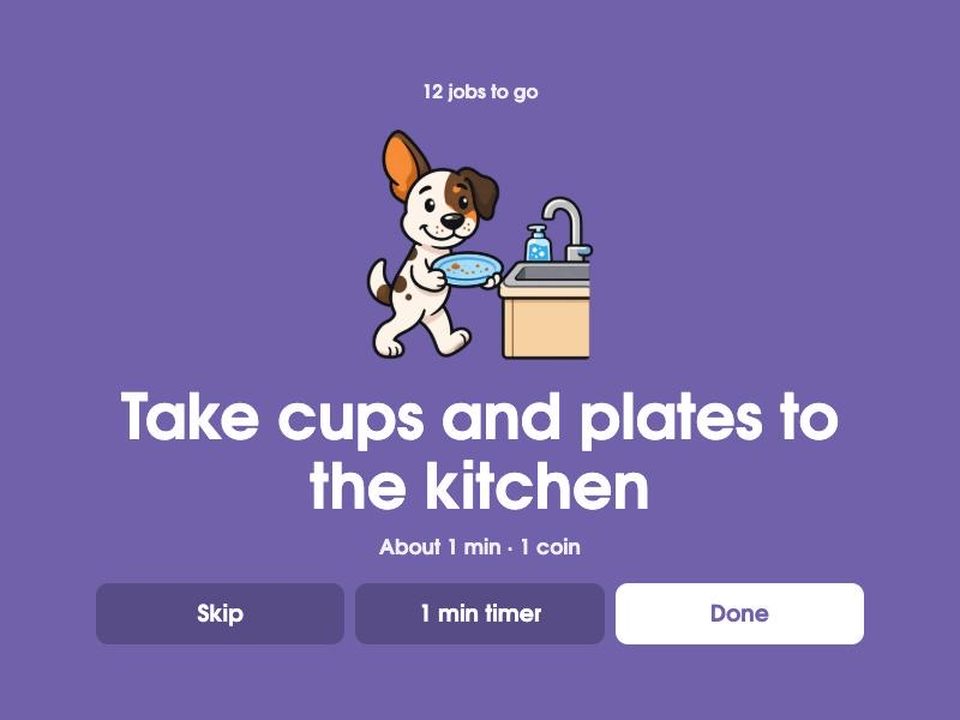
More about the chore chart and coins and rewards.
Setting it up
- On your phone, go to fridgeboard.me and tap Try it free. Add who lives at home.
- Add two or three chores per child, each with a finish-by time. Set the shared jobs to take turns.
- On the iPad, open Safari, go to fridgeboard.me, tap Open, then Use this as the shared screen, and scan the code with your phone.
- Put it where the kids walk past, and stop reminding. Check it at the finish time instead.
Questions
How do I get my kids to do chores without nagging?
Put each child’s chores where they’ll see them, give each chore a clear finish-by time, and let the chart or a timer do the reminding instead of you. Small rewards for finishing and calm, predictable consequences do the rest.
What do you do when kids refuse to do chores?
Stay calm and let a consequence you agreed in advance happen, like screen time starting after the chore is done. Check the chore suits their age and that they know exactly what done looks like.
Should I pay my kids to do chores?
It’s a family choice. Many families keep everyday chores unpaid and give allowance (pocket money) or coins for extra jobs, and small privileges like choosing the movie work well too.
How do you stop kids fighting over whose turn it is?
Write the rotation down and swap it each time the chore is done, or each day or week. A chart that shows whose turn it is ends the argument before it starts.
Do chore charts actually work?
They work best when they’re visible, short, and the same every day, and when parents check at the finish time instead of reminding.
Is there a chore chart that reminds kids so I don’t have to?
FridgeBoard shows each child’s chores on a tablet on the fridge, with finish-by times that turn red when late and chores that take turns. It’s one payment (US$24 plus tax in the US, A$39 in Australia), with no subscription.