Age appropriate chores for kids: a list by age
Updated November 2026
Most children can start helping at home from about two, with one-step jobs like putting toys in a box. By eight or nine they can feed a pet, put away their own washing and help cook, and by twelve they can clean a bathroom or do a load of laundry. Below is a chores-by-age list for 2 to 13+, a chart you can copy, and the things that make chores stick: how to teach one, how many to give, and whether to pay for them.
Every child is different. A careful six-year-old might fold washing better than a distracted nine-year-old, and some jobs depend on your kitchen, your dog and your patience. Treat the ages below as a rough guide: start a bit below what you think your child can do, and move up when they’re ready.
Chores for toddlers (2 to 3 years)
At this age a chore is one step, done with you, and it’s more about joining in than getting it done. Expect mess and keep it short.
- Put toys back in a box or basket
- Put dirty clothes in the washing basket
- Put books back on a low shelf
- Help feed a pet (you measure, they tip it in)
- Wipe up a spill with a cloth
- Hand you pegs or wet clothes when you hang the washing
- Carry unbreakable things to the shopping bags or the pantry
Chores for 4 to 5 year olds
Preschoolers can follow two or three steps and love being trusted with a “real” job. This is a good age to start a simple chore chart.
- Make their bed (pull the doona or comforter up, pillow on top)
- Set the table with plates and cutlery, and clear their own plate
- Feed the pet with a set scoop
- Water plants with a small can
- Match socks from the clean washing
- Tidy their room with help: toys, books, clothes in the basket
- Get dressed and put pyjamas under the pillow
Chores for 6 to 7 year olds
School-age children can do jobs on their own once they’ve been shown, and can start to remember them without being asked if the chart is somewhere they’ll see it.
- Make their bed properly
- Put away their own clean clothes
- Sort washing into lights and darks
- Wipe the table and benches after dinner
- Unpack their school bag and lunch box
- Empty small bins into the big one
- Sweep a floor or use a hand vacuum
- Help put the shopping away
Chores for 8 to 9 year olds
- Vacuum a room
- Walk the dog (with an adult or in a safe area)
- Put away groceries
- Make a simple snack or help cook dinner
- Fold and put away a basket of washing
- Take the bins or trash out on bin night
- Pack their own lunch with a checklist
- Clean the bathroom sink and mirror
Chores for 10 to 12 year olds
The American Academy of Pediatrics suggests that by 11 or 12, children can clean the kitchen, change their sheets, unload the dishwasher, do laundry, clean bathrooms and wash the car, and cook a simple meal with supervision (HealthyChildren.org, AAP).
- Load and empty the dishwasher, or wash up
- Change their own bed sheets
- Run a load of washing and hang it out
- Clean the bathroom: toilet, basin, shower
- Do some gardening, with supervision
- Cook a simple meal with an adult nearby
- Wash the car
- Mop floors
Chores for teenagers (13 and up)
Teenagers can do almost anything an adult does at home. The goal now is running things on their own: knowing the job needs doing, without a list.
- Cook a family dinner once a week, from planning to washing up
- Do all their own laundry
- Write the shopping list for a meal and buy it
- Clean the whole kitchen after dinner
- Mow the lawn with a push mower, with an adult around (the AAP says 12 and up for push mowers, 16 for ride-ons), clean the gutters with an adult, wash windows
- Look after younger siblings for a short time
- Clean out the fridge
A chores-by-age chart you can copy
Each age can also do everything in the rows above it. Copy this onto paper for the fridge, or use it to set up a chore chart.
| Age | Everyday chores | Weekly or bigger jobs |
|---|---|---|
| 2–3 | Toys in the box, clothes in the basket | Help feed the pet, help unpack shopping |
| 4–5 | Make bed, set the table, clear own plate | Water plants, match socks |
| 6–7 | Put away clothes, wipe the table, unpack school bag | Sort washing, sweep, empty small bins |
| 8–9 | Feed the pet, pack lunch, help with dinner | Vacuum a room, bins out, fold washing |
| 10–12 | Empty the dishwasher, wash up | Change sheets, clean bathroom, run a load of washing |
| 13+ | Clean the kitchen, own laundry | Cook a dinner, mow, clean the fridge, mind siblings |
How to teach a chore so it actually gets done
Most “they won’t do it properly” problems are really “nobody showed them what done looks like”. This takes a week or two per chore, and it saves months of arguing.
- Do it together first. You do it while they watch and help. Say the steps out loud.
- Then they do it while you watch. Bite your tongue. Only step in if something’s unsafe.
- Then they do it alone and you check. Praise the effort, then show one thing to fix next time, not five.
- Break it into steps. “Clean your room” means nothing to a six-year-old. “Clothes in the basket, books on the shelf, toys in the box, bed made” does. A picture for each step helps children who can’t read yet.
- Make it easy. A low hook for the towel, a step stool by the sink, a basket for each kind of toy. Half of getting kids to do chores is setting the room up so the job is possible.
- Same time each day. The AAP suggests having children do chores at the same time every day, so they become part of the routine like brushing teeth.
Introduce one new chore at a time. A long list on day one is overwhelming for children (and for you).
How many chores should a child have?
There’s no official number. As a rough guide, many families settle on something like:
- 2 to 5 years: 1 or 2 tiny jobs a day, done with you
- 6 to 9 years: 2 or 3 daily chores (about 10 to 15 minutes in all), plus one bigger job a week
- 10 to 12 years: 3 or 4 daily chores (15 to 20 minutes), plus one or two bigger jobs a week
- Teenagers: about what you’d expect from a flatmate: their own space, their own washing, and a fair share of the shared jobs
It matters more that the same few chores happen every day than that there are lots of them. On busy sport or exam weeks, drop to the essentials rather than abandoning the chart.
Should chores be paid? Allowance and pocket money
Families split on this, and there’s no wrong answer. The three common approaches:
- Unpaid family chores. Making your bed and clearing your plate are part of living in a house. Pocket money (allowance), if any, is separate.
- Paid chores. Each chore earns a set amount. It teaches that work earns money, but some children start asking “how much?” before helping with anything.
- A mix. Everyday chores are unpaid; extra jobs like washing the car or weeding earn money. This is the most common middle ground.
Paying for chores is common. Westpac’s 2025 survey of 1,007 Australian parents found 55% of children aged 8 to 17 earn pocket money for doing chores (Westpac, September 2025). In the UK, NatWest Rooster Money’s 2026 Pocket Money Index found making the bed was the most popular chore on its app, and mowing the lawn the best paid (NatWest Rooster Money).
A good in-between for younger children is coins or points that can be swapped for a treat or real money later. See our guide to pocket money and allowance by age for typical amounts.
Doing this with FridgeBoard
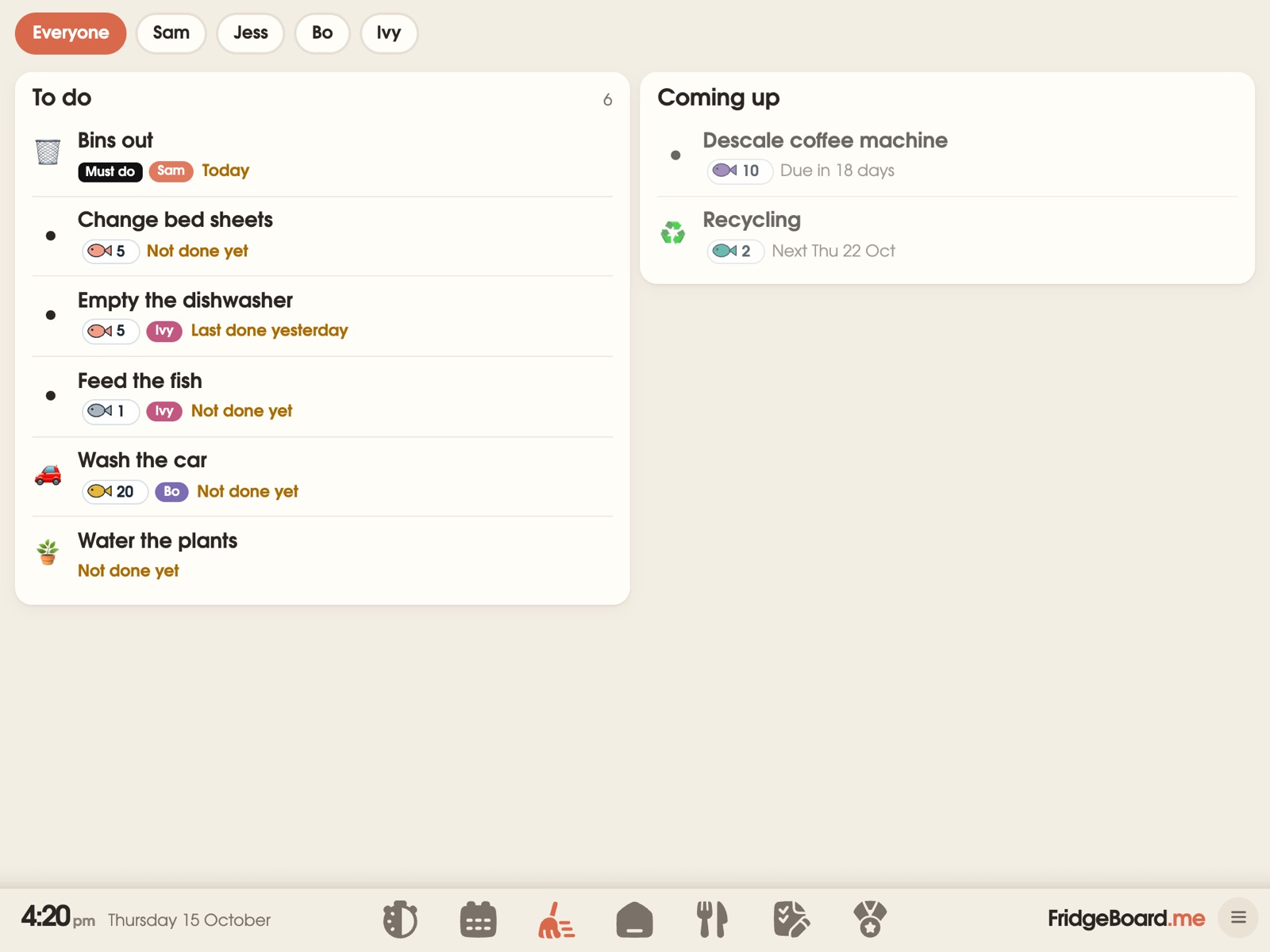
FridgeBoard is a chore chart on a shared screen: an iPad or tablet on the fridge or bench, kept in sync with every phone at home. Each child has their own card in their colour, with only their chores for today, so a five-year-old isn’t looking at their brother’s list.
- Chores repeat daily, on set days or every few weeks, with an optional time to finish by. They turn red if they’re missed.
- Chores can have steps, so “clean your room” shows exactly what done looks like. Jobs that nobody owns, like the bins, can be ticked by whoever does them.
- Chores can take turns between children, so FridgeBoard knows whose turn it is to empty the dishwasher.
- Chores can earn coins for a shop you fill, including real pocket money at a rate you choose. Coins are optional. More about rewards.
For more on the chart itself, see the chore chart and our guide on getting kids to do chores without nagging.
Setting it up
- On your phone, go to fridgeboard.me and tap Try it free. Add who lives at home.
- Add two or three chores per child from the lists above. Pick how often, and coins if you want them.
- On the iPad, open Safari, go to fridgeboard.me, tap Open, then Use this as the shared screen. Scan the code with your phone.
- Put the iPad on the fridge or bench, where the kids walk past it.
Questions
What chores can a 3 year old do?
A 3-year-old can do one-step jobs with an adult: put toys in a box, put dirty clothes in the basket, put books on a low shelf, wipe a spill and help feed a pet. Keep it short and expect to help.
What chores should a 7 year old do?
A 7-year-old can usually make their bed, put away their own clothes, wipe the table, unpack their school bag, sort washing and sweep a floor. Two or three daily chores of about 10 to 15 minutes in all is a common amount.
What chores can a 10 year old do?
A 10-year-old can often empty the dishwasher, vacuum, take the bins out, fold and put away washing and help cook dinner. By 11 or 12, many can change their sheets, clean a bathroom and do a load of laundry.
At what age should kids start doing chores?
Most children can start helping from about 2 with simple one-step jobs done alongside a parent. A regular chore chart usually works from about 4 or 5.
Should kids get paid for chores?
It’s up to each family. Many keep everyday chores unpaid and pay allowance (pocket money) for extra jobs, and some use coins or points that can be swapped for treats or money.
How many chores should a child have?
As a rough guide, 1 or 2 small jobs a day for preschoolers, 2 or 3 for primary school children, and 3 or 4 plus a weekly job for 10 to 12 year olds. Doing the same few every day matters more than the number.
Is there a chore chart that shows chores by age on the fridge?
FridgeBoard puts a chore chart on an iPad or tablet on the fridge, with each child’s own chores on their own card and every phone at home kept in sync. It’s one payment (US$24 plus tax in the US, A$39 in Australia), with no subscription.