Home › Guides › Bedtime routine
A bedtime routine for kids that actually works
Updated November 2026
A good bedtime routine for kids is three or four calm steps, done in the same order every night, taking about half an hour: something like bath, pyjamas, teeth, story, lights out. Work back from the time your child needs to wake up, using how much sleep their age needs, and start the routine half an hour before that. Below are example routines for toddlers to tweens, a sleep-by-age table, and fixes for the common snags, like two kids and one bathroom.
How much sleep do children need?
These are the recommended hours of sleep in every 24 hours, from the American Academy of Sleep Medicine, as published by the CDC (CDC). Naps count for the younger ages.
| Age | Recommended sleep |
|---|---|
| 4–12 months | 12–16 hours, including naps |
| 1–2 years (toddlers) | 11–14 hours, including naps |
| 3–5 years (preschool) | 10–13 hours, including naps |
| 6–12 years (school age) | 9–12 hours |
| 13–17 years (teens) | 8–10 hours |
It’s a range, not a target. A child who wakes up on their own, cheerful, and doesn’t melt down by 4pm is probably getting enough.
Working out bedtime
Start from wake-up time, because that’s the one school decides for you. Take away the hours of sleep your child needs, then about 15 minutes to fall asleep, then the length of the routine.
For example, a 7-year-old who wakes at 6:45am and does well on about 10½ hours:
- Asleep by about 8:15pm
- Lights out at 8pm
- Bedtime routine starts at 7:30pm
Keep wake-up time about the same on weekends. The Sleep Foundation notes that sleeping in more than about an hour can make it harder to fall asleep on school nights (Sleep Foundation).
What makes a bedtime routine work
- Same steps, same order. The Sleep Foundation suggests three or four activities, always in the same order, taking around half an hour, or a little longer with a bath.
- Screens off early. The American Academy of Pediatrics recommends turning off all screens at least an hour before bedtime and keeping them out of bedrooms (HealthyChildren.org, AAP).
- Dim the house. Lower lights in the half hour before bed tell everyone the day is winding down.
- One clear end. Lights out is lights out. A fixed “one more story” rule (exactly one) avoids the nightly negotiation.
- Children can see where they’re up to. Asking “what’s next?” is much easier than being told for the fifth time to brush their teeth.
Toddler bedtime routine (1 to 3 years)
Toddlers need you for every step. Keep it short and very predictable; the AAP’s “brush, book, bed” is the core of it.
| Time | Step |
|---|---|
| 6:30pm | Bath (10 minutes) |
| 6:40pm | Nappy or toilet, pyjamas |
| 6:45pm | Brush teeth |
| 6:50pm | One or two books in bed |
| 7:00pm | Cuddle, song, lights out |
Baths don’t need to be every night. On non-bath nights, start ten minutes later, or swap in a quiet puzzle.
Bedtime routine for 4 to 6 year olds
Preschoolers and young school children can start doing steps alone, especially with a picture chart to follow.
- Pack away toys (5 minutes)
- Bath or shower (10 to 15 minutes)
- Pyjamas on, clothes in the basket
- Toilet and brush teeth
- Story in bed (10 minutes)
- Lights out, about 7 to 7:30pm
Bedtime routine for 7 to 12 year olds
Older children can run most of the routine themselves. Add the jobs that make mornings easier, and give them a finish time instead of a start time.
- Pack school bag for tomorrow, clothes out
- Shower
- Pyjamas, teeth
- Screens handed in or put on the charger outside the bedroom
- Read in bed (15 to 20 minutes)
- Lights out, about 8 to 9pm depending on age and wake-up time
Teenagers mostly set their own routine, but the same ideas help: phones charging outside the bedroom, and a regular wake-up time even on weekends.
Two kids sharing a bathroom: stagger the start
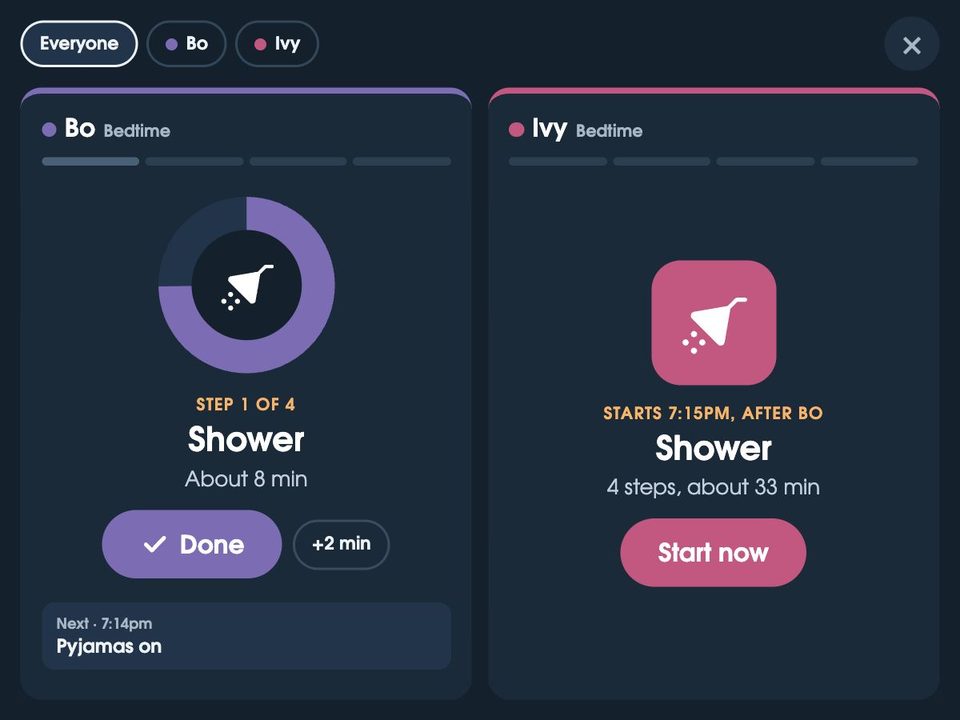
If two or three children all start bedtime at 7pm, you get a queue at the bath and someone waiting in a towel. The simple fix is to start them apart.
- Youngest goes first. They need the earlier lights out anyway. Start the younger child at 6:45pm and the older one at 7:15pm.
- The older child does the quiet steps first. Bag packing and laying out clothes while the bath is busy, then shower and teeth when it’s free.
- Take turns where it can’t be helped. If the shower is the bottleneck, one child’s “in the shower” is the other’s cue to brush teeth in the kitchen or get pyjamas on.
Writing each child’s routine down with its own start time removes most of the arguments. Nobody’s waiting, so nobody’s yelling through the door.
Visual bedtime charts for kids who can’t read yet
A picture for each step lets a three or four-year-old follow the routine without you reading it out. Picture charts help children who can’t read yet follow along. Some ideas:
- One picture per step, in order, left to right or top to bottom. A bath, pyjamas, a toothbrush, a book, a moon.
- Something to move. A peg or magnet they slide along as each step is done, so they can see what’s left.
- Keep it where it happens. At their height, by the bathroom or bedroom door, not stuck high on the fridge.
- Same pictures every night. Change the routine rarely, and change the chart when you do.
Doing this with FridgeBoard
FridgeBoard puts each child’s bedtime routine on the shared screen in the kitchen, and walks them through it one step at a time: the step they’re on, about how long it takes, and what’s next. Tap Done, and the next step comes up.
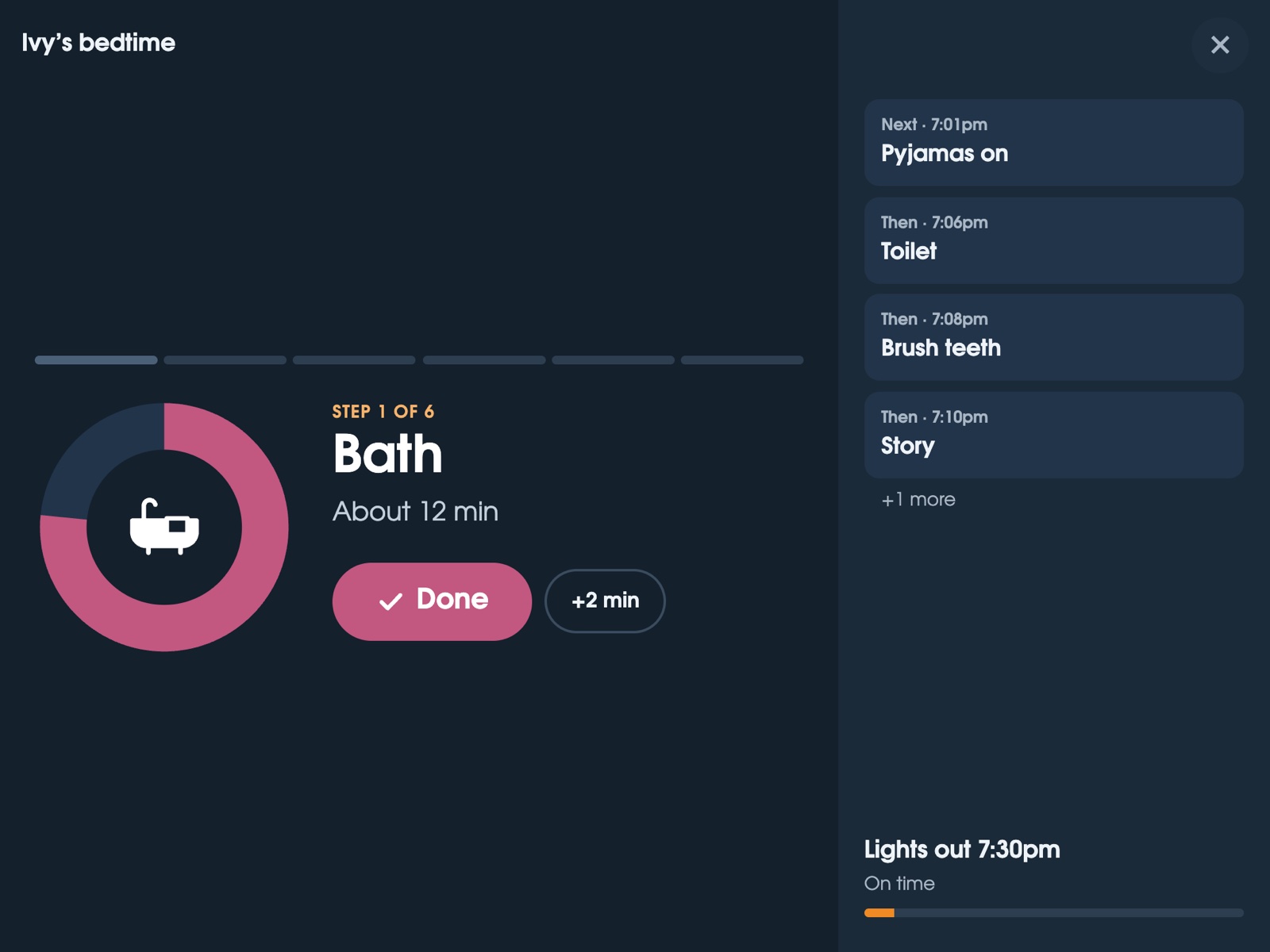
- Set a time to start, or a finish goal children can read (“Finish goal: 7:30pm”). If they’re running behind, it says so.
- For children who can’t read yet, Max the dog shows each step in a picture, and steps can be read aloud.
- Children on the same routine can start a few minutes apart, so nobody waits for the bathroom.
- Routines can be paused while you’re away, and changed from any parent’s phone.
More about routine charts for kids, including morning routines.
Setting it up
- On your phone, go to fridgeboard.me and tap Try it free. Add who lives at home.
- Add a bedtime routine for each child, with its steps and a start time or finish goal.
- On the iPad, open Safari, go to fridgeboard.me, tap Open, then Use this as the shared screen, and scan the code with your phone.
- At bedtime the routine opens on the screen by itself.
Questions
What is a good bedtime routine for kids?
Three or four calm steps in the same order every night, such as bath, pyjamas, teeth and a story, taking about half an hour. Screens off an hour before and a set lights-out time help too.
What time should a toddler go to bed?
Toddlers aged 1 to 2 need 11 to 14 hours of sleep in 24 hours, including naps, so a bedtime around 7pm is common. Work back from the time they usually wake up.
How much sleep does a 7 year old need?
Children aged 6 to 12 need 9 to 12 hours a night, according to the American Academy of Sleep Medicine. A 7-year-old waking at 6:45am would usually be asleep by about 8 to 8:30pm.
How long should a bedtime routine take?
About 30 minutes for most children, or a little longer when there’s a bath. Longer routines tend to push bedtime later.
How do you do bedtime with two kids and one bathroom?
Start their routines at different times, usually the youngest first, so they need the bathroom one after the other. The older child can do quiet steps like packing their bag while they wait.
What is a visual bedtime routine chart?
A chart with a picture for each bedtime step, in order, so children who can’t read yet can follow it themselves. Moving a peg or ticking each step shows them what’s left.
Is there a bedtime routine app for the fridge?
FridgeBoard shows each child’s bedtime routine on an iPad or tablet in the kitchen, one step at a time, with pictures for children who can’t read yet. It’s one payment (US$24 plus tax in the US, A$39 in Australia), with no subscription.